

| Marked | 925 S (silver fineness 925/1000) |
|---|---|
| Execution | Georg Jensen, Copenhagen Denmark between 1933 and 1944 |
| Condition | This object is in very good condition, Some minor scratches consistent with age and use. No dents or inscriptions. |
| Literature | Janet Drucker (ed.), Georg Jensen: A Tradition of Splendid Silver |
| Dimensions | Height 10 cm |
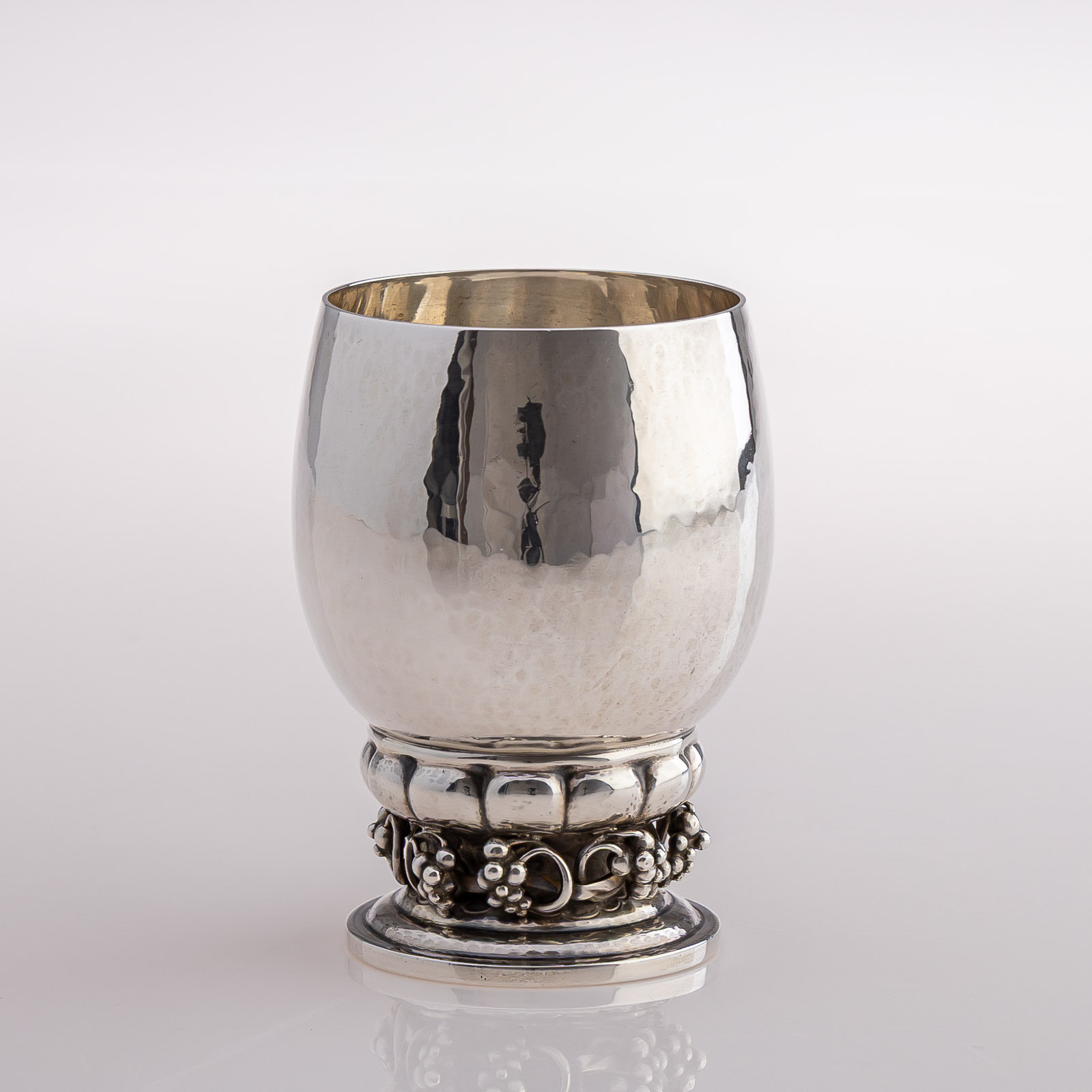
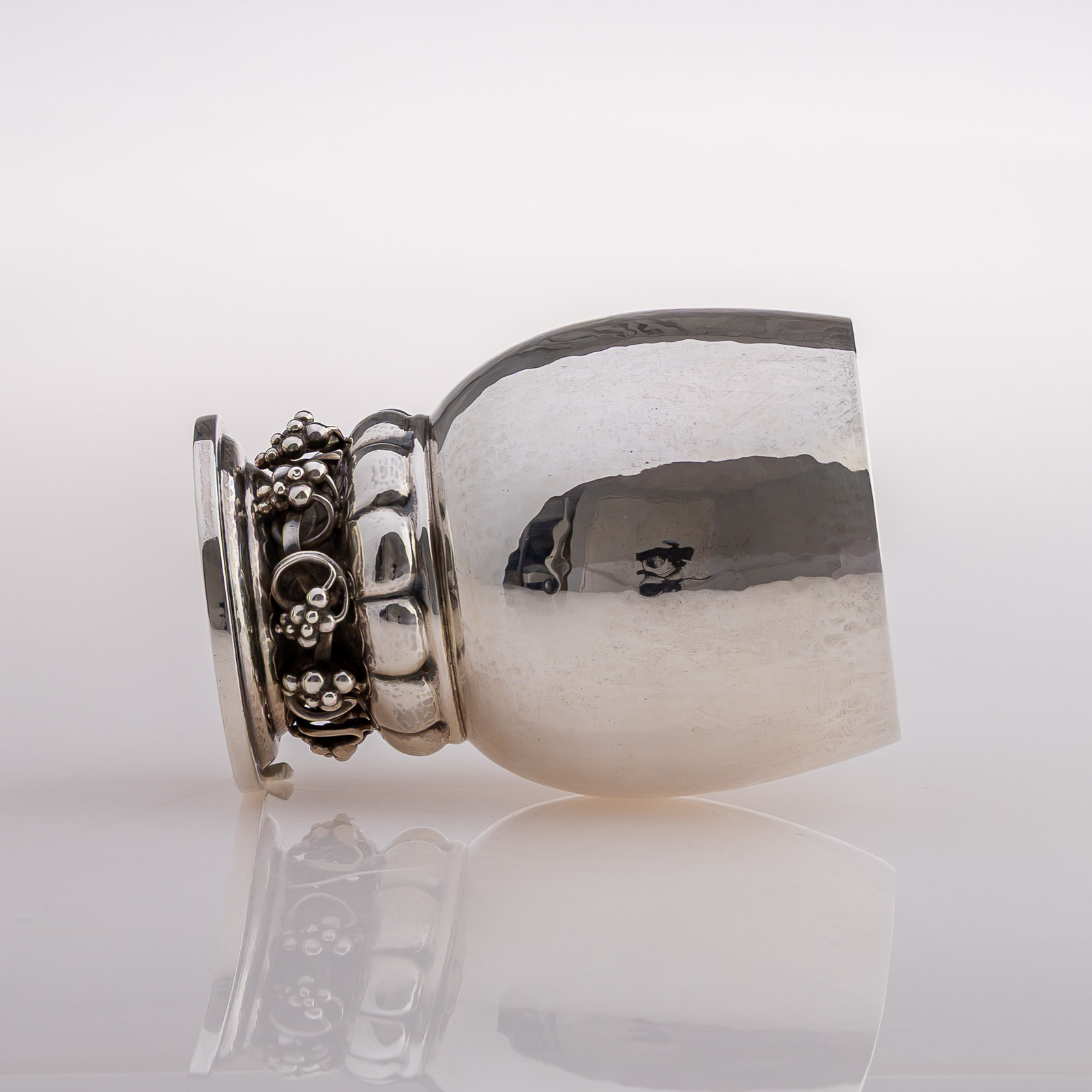
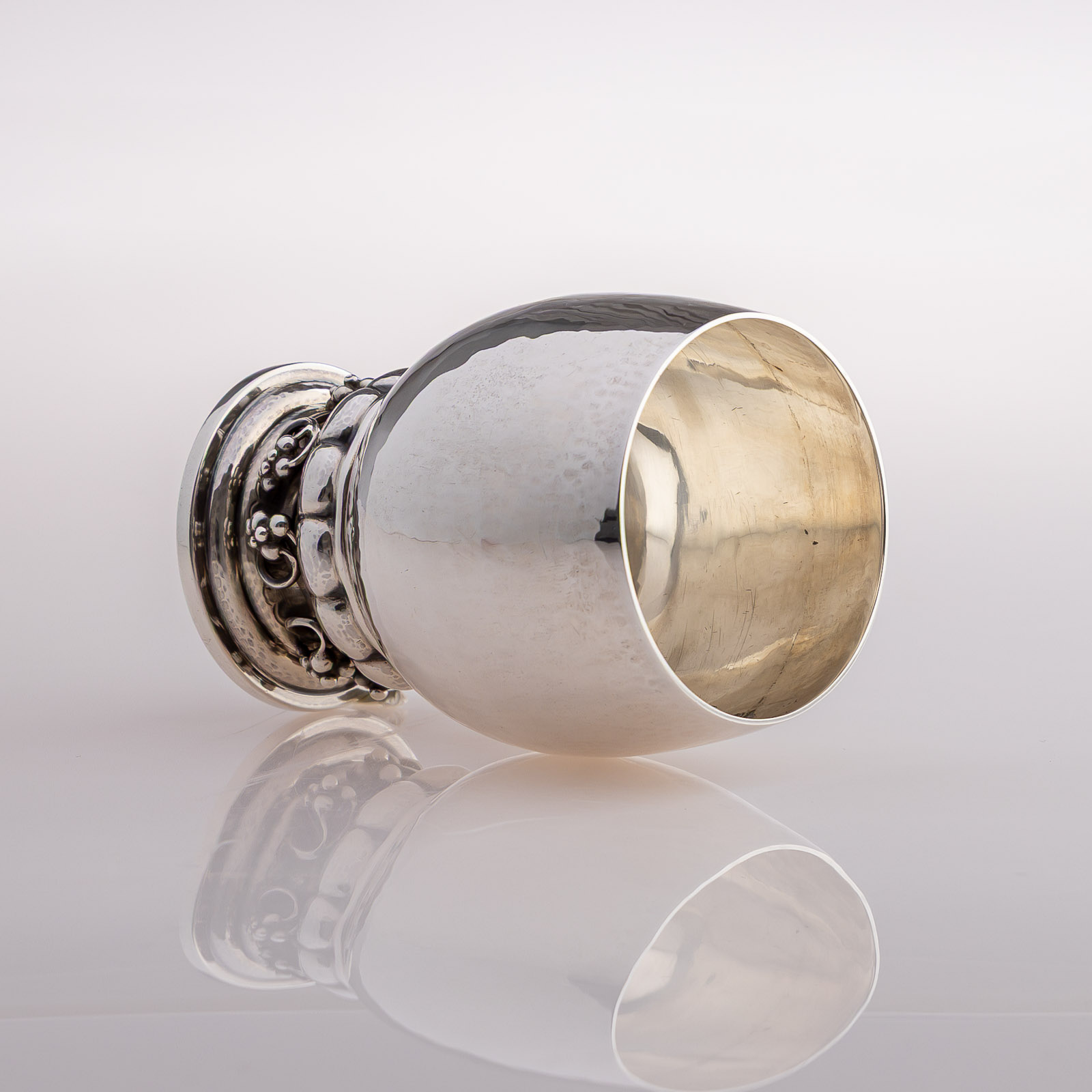
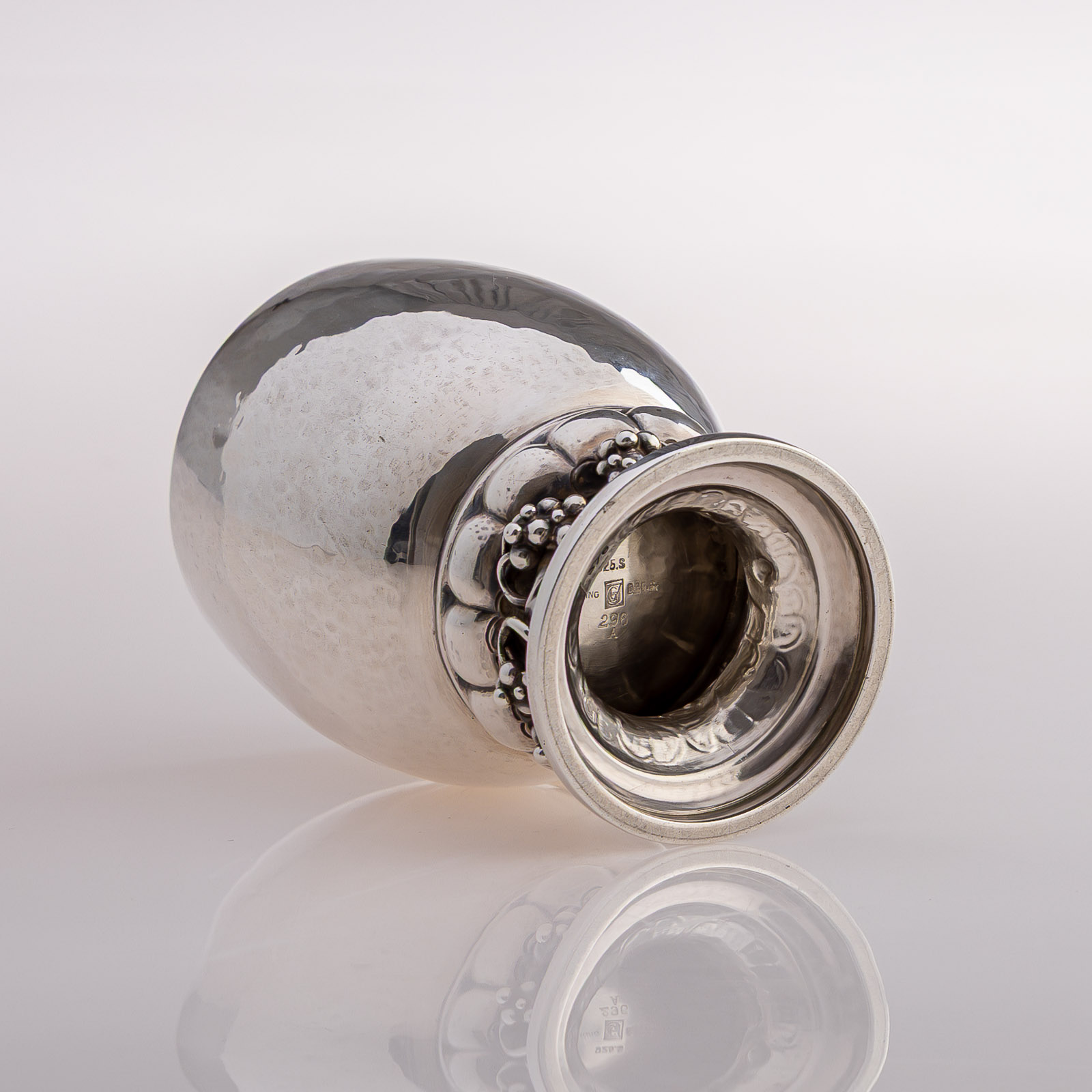
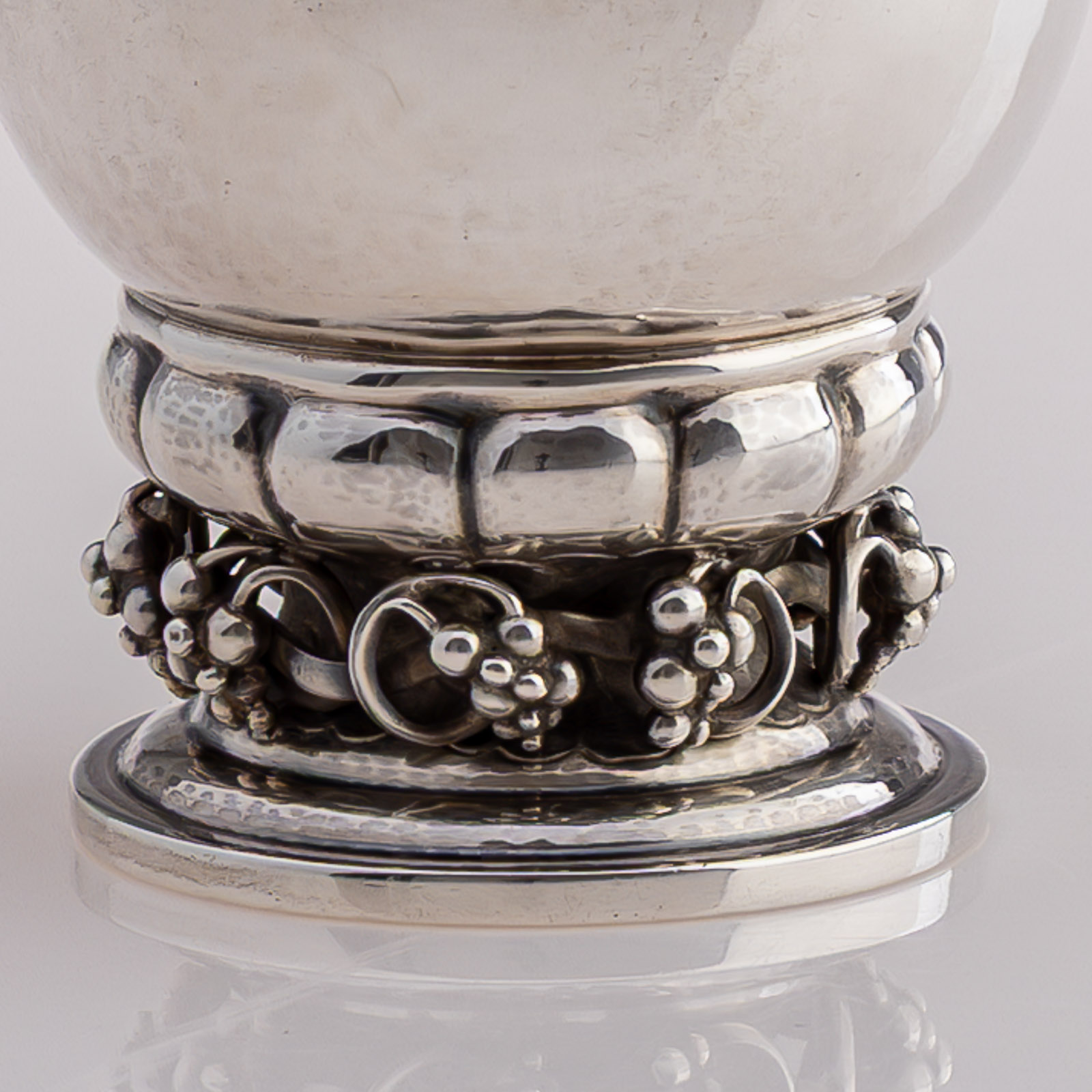
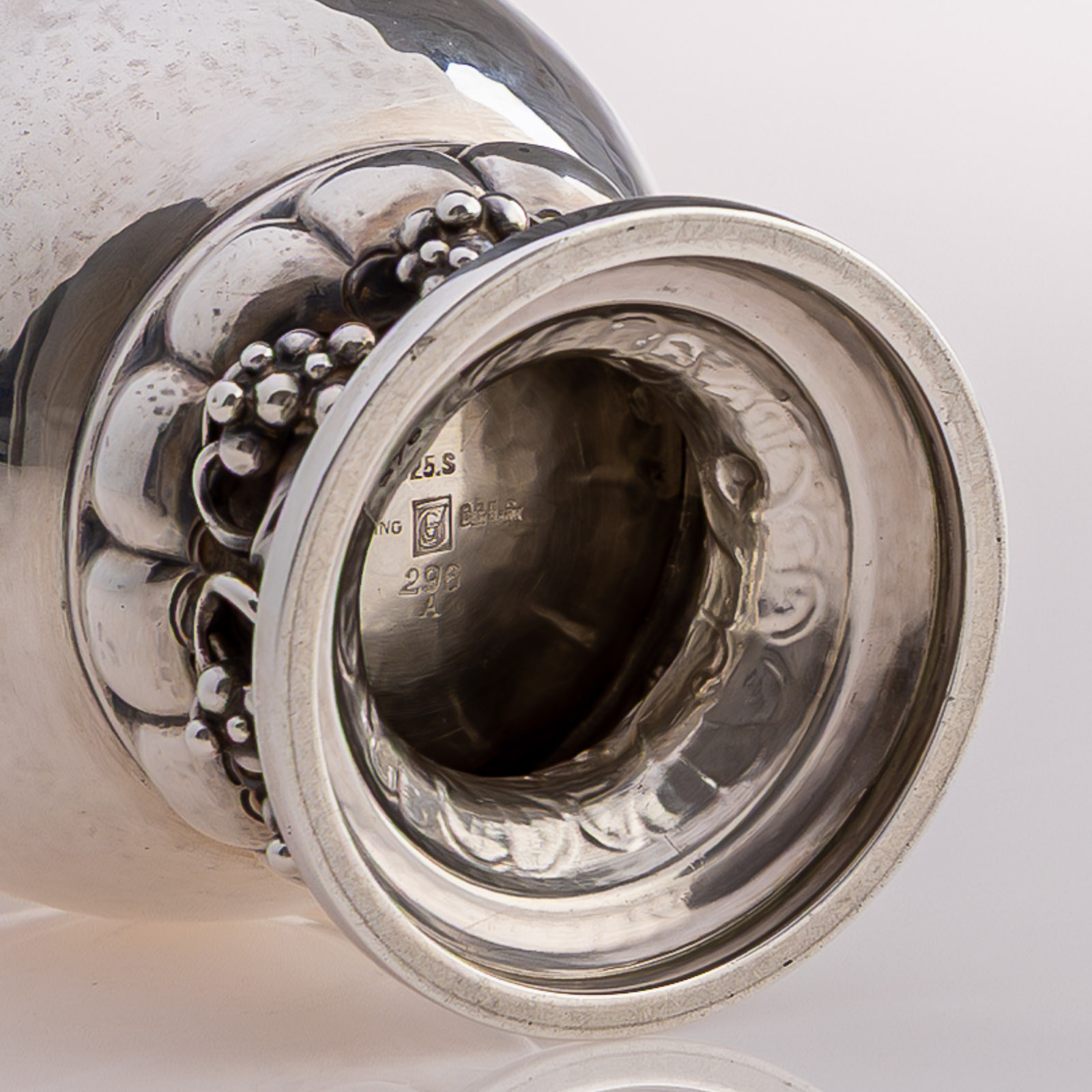
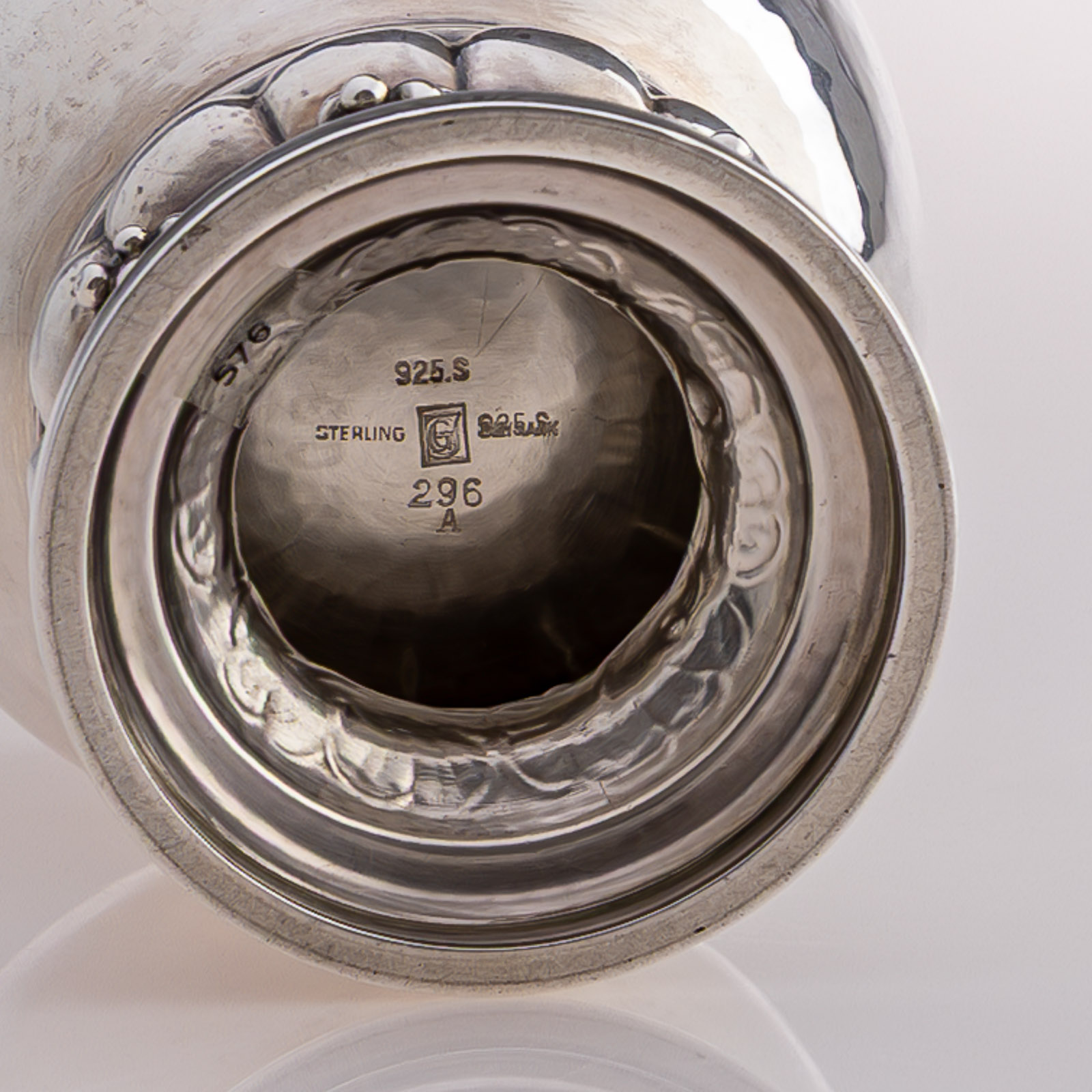
Georg Jensen – A silver beaker ‘Grape’, model 296A – Georg Jensen, Denmark 1933-1944
SOLD
Uitverkocht
Designed by Georg Jensen in 1917, the Grape Beaker, model 296 A is an example of his early Art Nouveau silverwork. The design combines a gently flared cup with a sculptural stem decorated with clusters of grapes and vine leaves. The naturalistic ornamentation and softly modelled forms are characteristic of Jensen’s work during this period.
This example of 10 cm in height and is in very good condition, with no dents or inscriptions. Some minor scratches consistent with age and use.
About Georg Jensen
Georg Jensen (Raadvad, Denmark 1866 – Copenhagen, Denmark 1935) was a Danish silversmith, sculptor and designer who played an important role in the development of Scandinavian silver design during the early twentieth century.
Born in Raadvad, north of Copenhagen, Jensen initially trained as a goldsmith before studying sculpture at the Royal Danish Academy of Fine Arts, which he entered in 1887. After working as a sculptor and ceramicist, he returned to metalworking in 1901, joining the workshop of the Danish artist and silversmith Mogens Ballin. In 1904, Jensen established his own silversmithy in Copenhagen, initially concentrating on silver jewellery before expanding into hollowware and cutlery.
His early work was influenced by the Art Nouveau movement, combining organic forms inspired by nature with traditional Danish craftsmanship. Jensen developed a distinctive style characterised by sculptural shapes, restrained ornamentation and softly hammered silver surfaces. Floral motifs, leaves, berries and other natural elements frequently appeared in his designs, while the use of oxidised details emphasised their sculptural qualities. His background as a sculptor remained evident in the proportions and modelling of his silver objects.
Jensen’s approach to silver design also reflected the principles of the Arts and Crafts movement, particularly its emphasis on craftsmanship and the relationship between form and function. His Continental cutlery pattern, introduced in 1906, demonstrated a more restrained approach to ornamentation. In his hollowware, he combined traditional silversmithing techniques with forms that departed from the historicist styles prevalent during the nineteenth century.
From an early stage, Jensen invited other artists and designers to contribute to his workshop. His collaboration with the painter and designer Johan Rohde began in 1906 and resulted in several important designs, including the Acorn cutlery pattern of 1915. Other designers, among them Harald Nielsen and Sigvard Bernadotte, subsequently contributed to the development of the company. This collaborative approach allowed the silversmithy to accommodate different artistic directions while maintaining its emphasis on craftsmanship.
The company expanded internationally during Jensen’s lifetime, establishing a presence in Berlin, Paris and London between 1909 and 1921, followed by its first American store on Fifth Avenue in New York in 1924. By the time of Jensen’s death in 1935, the silversmithy had developed an international reputation for its jewellery, silver hollowware and cutlery. In the following decades, designers such as Henning Koppel introduced a more explicitly modernist approach, contributing to the company’s continued development within Scandinavian design.
Jensen’s work is represented in several international museum collections, including the Metropolitan Museum of Art in New York, the British Museum in London and the Royal Ontario Museum in Toronto. The Metropolitan Museum holds examples of his silver hollowware, including a monumental tureen dating from around 1925. An important early recognition of his work came in 1914, when the Musée du Louvre in Paris acquired a silver bowl designed in 1912, subsequently known as the Louvre Bowl. His work remains an important reference in the history of Danish silversmithing and twentieth-century decorative arts.


